
Another Deluge

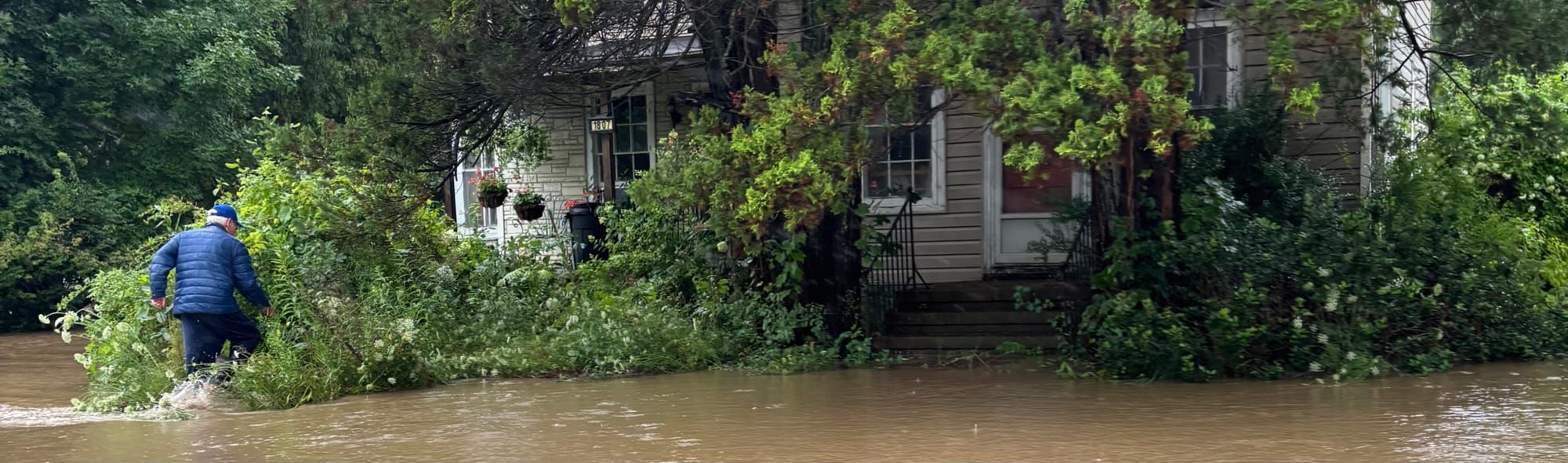
Last week, we drove through the Hudson River Valley, doing our best to dodge the final few punches of a storm that dropped twelve inches of rain on our destination in the Catskills. The Catskills, you may know, are the result of millions of years of sediment from the bottom of ancient streambeds piling up, lifted by tectonic action, and carved by glaciers and water. The net effect is that the Catskills don’t gradually rise or slope downhill to rolling farm country like the Adirondacks, or our Grand Monadnock. The Catskills simply end in places, terminating in a cliff face. On an average day, the effect is dramatic winding up route 23 from Palenville, through Kaaterskill Falls, climbing past treetops. Add a torrent of water cascading over mountain edges from above and around you following twenty-four hours of continuous, heavy rain, and the effect is Jurassic.
By the morning after our arrival, Catskill and Hudson River Valley locals were referring to the storm as a one-thousand-year flood event, up from the usual one-hundred-year event. They got that idea from unnamed experts. I may not have made anyone feel better expressing sympathy for their ordeal, pointing out that it was a year ago, at the same time, when Hancock was deluged by a storm that sat over town for hours, ending with accumulations of eight to twelve inches, and washing away our roads with glacier-like ease. I have already entered “heavy rain” in the calendar across the last week of July 2027, conscious that one-thousand-year events are now part of the active roster.
Around here, we will need to harden our roads. In the Hudson River Valley, they will need to harden their basements and farmland. The wipers beat steadily across our windshield for the duration of the four-hour drive, and we made reasonably good time until we started across the river valley—in places, more river than valley. In the hamlet of Craryville, traffic took turns using one lane to pass through fast-moving water spilling over the banks of Taghkanic Creek. As we crept along, we encountered an older man, hat, coat, Wellington-style boots, making his way back across the road in front of us after conferring with utility people working near their emergency trucks, yellow lights flashing. He reached the right-hand side of the road, and the water topped his boots. Several more strides, dragging his legs through the surf, and he was at the side door of his farmhouse, where the water was admitting itself without invitation. My wife took a picture. OMG, is the useful, modern abbreviation for what she had to say.
We enjoy the wind whistling through our house, and sunshine through the windows. But water that finds its way inside is on the order of a snake slithering across the floor. Or mice in the walls, or spiders in the corners. As we would be hearing footsteps on the gravel path, we are awakened abruptly at night by the eerie drip, drip, drip of rain that finds its way past the chimney flashing to splash on the mantle. We have always had a penchant for old houses, which often means dug basements. “Does it flood?” I learned to ask. “Sometimes,” the sellers learned to answer. I left hip-waders at the top of the basement stairs in one house to rescue what was adrift when it flooded—which was always after an inch of rain.
It is a clear day as I write this. But I have emptied the rain gauge twice in the past week of three inches of water. That’s six inches total against July’s average, in these parts, of three, to three-and-a-half. Out west, they are still trapped in severe drought conditions. But according to the U.S. Drought Monitor, gradually things are improving. Much of the East Coast is forecasted to emerge from drought conditions this month, including New Hampshire. We can hope relief comes soon to our western neighbors so they can worry less about fires.
Interestingly, by the late Jurassic period, sea levels were upwards of 250 feet above where they are today.