Frozen
Irony is at work in global warming, tempting bluebirds north for the winter to be sandbagged by frigid temperatures.

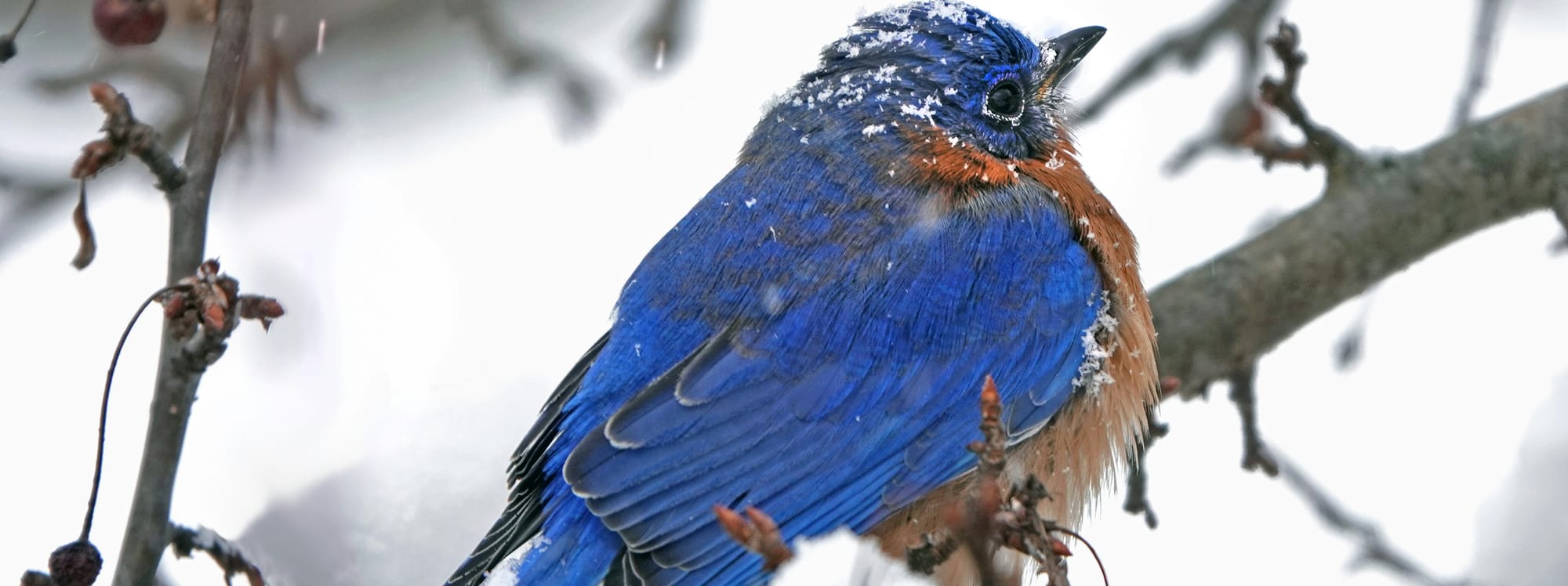
We are worried about a pair of Eastern Bluebirds we saw on the branch of an ash tree outside our window last week when the temperature was hovering around four degrees. Their cinnamon chests were puffed up to down vest proportion, and it seemed possible they were hoping for an invitation to come inside. A quick search online told us that the winter range of the bird has been drifting northwards, so no need to panic. It is not uncommon anymore to see bluebirds here in January as a function of our gradually warming winters.
Tell that to the bluebirds. These creatures mate for life, and it occurs to me that, this cold winter, one of them may have begun questioning the wisdom of remaining in New Hampshire for the season. Domestic bliss could be at stake. I try not to be sexist, but I suspect it was the male who argued for sticking around when the other bluebirds were heading to South Carolina. Save the miles and the calories, he would have argued. I am being that way about heating with wood, keen to save on propane. Plus, wood is renewable. But it is cold in the corners of our cabin, and there is all the schlepping and wood debris caught in the carpet. I feel sure one bluebird is reminding the other that keeping warm uses vital calories. And, how many calories are available to keep warm outdoors, in four degrees, when you weigh only an ounce? Where is an out-of-town bird likely to find new calories in this weather!
Etc.
Irony is at work in global warming, tempting bluebirds north for the winter to be sandbagged by frigid temperatures. A good portion of the country is in the frozen zone because warm air has opened the gate that would normally hold back the arctic air, so it is having its way with us—which would be fine if it would stay through summer to help with the fires and oppressive heat that is troubling many regions.
I can’t remember a stretch of cold like this. I have been through ice storms that took out the power for a few days. The cold will get after you in those circumstances, following you indoors. I arrived home from boarding school one winter vacation after such a storm and crawled under the covers in my bedroom where the temperature had dropped to the mid-thirties. I have a clear recollection of lying on my back, a maroon red sort of eiderdown pulled up to my chin, and a cold nose. My mother stood over me suggesting I might be more comfortable downstairs, in a sleeping bag in front of the fire. I was happy to be in my own bed after months away, and more interested in the sight of my frozen breath dissipating overhead. The temperatures were, at least, in the thirties, and the family was successful over the course of the outage keeping the pipes from bursting by holding candles to elbow joints of the copper baseboard heating. We would have been doomed if temperatures had remained as they are now, in the single digits, for days.
The leaves of the rhododendrons are folded as tight as a cocktail umbrella. It is the only plant I know that looks unhappy in the cold. Its countenance shivers and complains. If my wife is reincarnated as a plant, it could be as a rhododendron—lovely blossoms, evergreen, hardy and tenacious, quite miserable in bitter cold. The spruce and the hemlocks, on the other hand, standing among their barren hardwood neighbors, project the sure-footed confidence of fishermen in rough seas. It is the cold that sets them apart. They like it like this, same as the moose.
In the icy cold, the snow has remained light and easy to shovel. It slips through my gloved fingers like sugar, and squeaks underfoot. Plenty still clings to the hemlock branches, but drifts away as powder if a breeze comes along, which is a net positive. In warmer conditions, snow from branches can drop directly between the collar of your coat and your neck if you happen to be underneath, and there are few things more distracting. It was a common torment as children to have someone sneak up and slip a mitten full of snow down your back. Everything would have to come undone in that instant to purge the melting ice before it reached your belt line.
At least daylight now extends past Huckleberry’s supper time. We can feel more secure he won’t run into porcupines or coyotes. I don’t think much about the danger from coyotes. We are surrounded by them, but Huck would represent an elevated risk compared to rabbits, voles, squirrels and such. Or house cats. But, let’s face it, with his dog friends, Huck is a trial, jumping, barking, nipping at their heels to get them to run. A bit of a brat. He would be the same with coyotes, I’m sure, and they’d have none of it. Happily, he is back indoors before it is dark, chased in by cold, not coyotes.
It is dark now, and Huckleberry is curled up inside. The wind is banging against the windows in defiance of our warm cabin. We haven’t seen the bluebirds in a week. Maybe tomorrow.