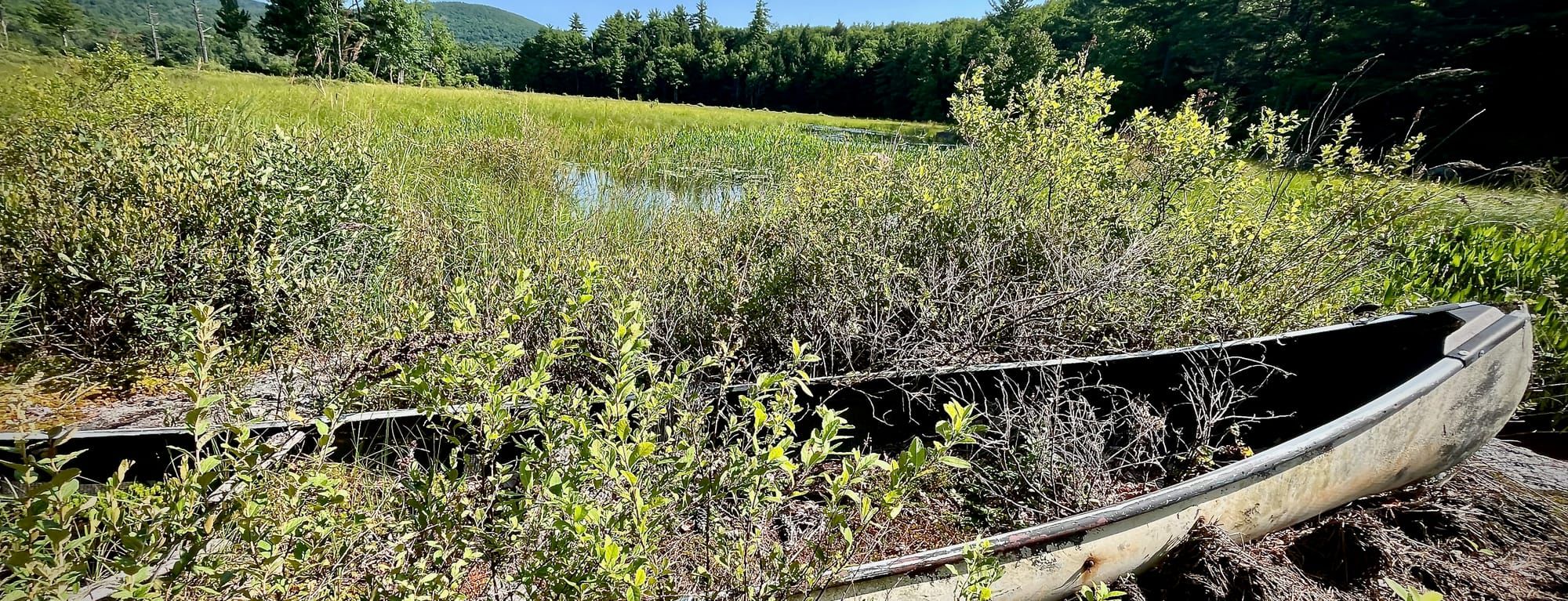
An Old Canoe
Where is the person who embarked with it on those waters? It must have been someone like me, who desired a hidden canoe to hop across nature’s boundary.

I walked dogs with a good friend for many years, and he took me on several excursions away from the usual places, on off-trail gems that he had frequented going back to his days as a teenager—a long time ago. Most of us know the pleasure of introducing our past to partners and friends, or our children. Who has not diverted to drive by the house where they grew up, maybe with someone else in the car. The action goes something like this: Slow down, so we can look, which allows time for everyone to get what they can from the place before it is left behind again.
Over the years of walking, my friend sought advice on a guidebook he was going to produce detailing his catalogue of “hidden” trails. He described it at length. I encouraged him throughout. Finally, he announced there would be no guidebook. What was the point of a guidebook of hidden trails? How would others know them, as he wanted them known, without him, as it were, behind the wheel? And what of the effect of so many more feet trampling over his secret treasures?
I use this to explain my decision not to share where I have found an old canoe. Not in a place that my friend showed me, though we walked nearby many times. It is down a ravine, upstream from rapids running through dark woods, at the edge of the sort of water where a canoe ought to belong—where one is, in fact, and has been for so long that it has gone from belonging to becoming, dissolving into the spot where it was left.
It would have been no easy task to get it there. There are other places I know where I wish I had a canoe to take on the water. We hiked to one of them this morning, mostly uphill, maybe a mile to the end, where there is a large pond with lilies flowering on the surface. Alas, there was no chance to drift among them. All we could do was stand on the shore and look, prevented from experiencing it firsthand as a parade of young mallards was able to do, keeping a safe distance on the far side.
A mile-long portage with a canoe would take some muscle—more muscle than I have anymore, even as one of two doing the carrying. The first summer camp experience I had was in Algonquin Park, one hundred eighty miles north of Toronto. I was ten, and everything I learned about canoeing, I learned there, in heavy wooden canoes. We were taught to kneel in the boat—there were no seats—with both occupants of the canoe paddling on the same side so that the canoe never traveled flat, but heeled to the side, like a sailboat, our bottom hand gripping the blade of the paddle so that our fingers swept underwater on each stroke. This was how Indigenous people canoed, we were told. And this was how we would do it, making sure the paddles never sent reverberations across the water by striking the gunwales. Because canoes prefer a world without uproar.
When it came time to portage, the camp’s older boys and counselors, high school and college-aged, carried the canoes, solo, on their backs, a towel across their shoulders on which to rest the center thwart, while they held the canoe in place by holding the front thwart. I weighed, maybe, fifty-five pounds when I was ten. I was awed by those displays of power, following those boys with my pack as they hiked nimbly over trails with the boat on their back. One of them would be all I needed, today, to help me stow a canoe in the reeds of a hidden pond, deeper in the woods, offering me the chance to hop across nature’s boundary. How like having wings to be able to venture to the middle of undisturbed waters.
I wonder if the canoe against which I have rested a couple of times expected to live out its days on this shore. Where is the person who once embarked with it on those waters? Gone to the city, perhaps. A thousand miles away. Swept downstream by life’s disturbances, and forced to kick off the ruby slippers. They left no guidebook or journal. But it must have been someone like me, who desired a hidden canoe to hop across nature’s boundary, who was intrepid enough to get it there, and young enough, such that the canoe has had time to grow old and gray, with grass up through the floor, and acorns piled in the corners.
Still, it manages to say, Slow down. Take a look.
And a heron takes off.